Cascading
Oracle GoldenGate supports cascading synchronization, where Oracle GoldenGate propagates data changes from the source database to a second database, and then on to a third database or multiple target databases.
See Configure a Cascading Topology Replication for sample automation scripts to run a Cascading data replication scenario.
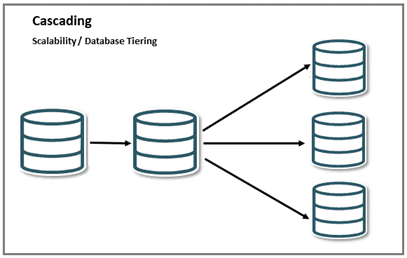
Description of the illustration cascading.png
The workflow in this type of configuration is as follows: 1. An Extract on the initial source writes captured data to a local trail, and a DISTPATH sends the data to a remote trail on the transitional system in the cascade.
-
On the second system, Replicat applies the data to the local database.
-
Another Extract on the second system captures the data from the local database and writes it to a local trail.
-
A DISTPATH sends the data to a remote trail on the final system in the cascade, where it is applied to the local database by another Replicat.
This workflow is depicted in the following diagram:

Description of the illustration cascading_workflow.png
A cascading configuration can be used for any of the following real-world scenarios:
-
Scalable Data Replication Configuration: To scale the data replication framework on to multiple deployments, when replicating from one source database on to secondary and then eventually a target database.
-
Data Tiering: To create multiple tiers for data replication set up, you can build a cascaded environment over local and remote hosts.
-
Extended environments: To configure extended environments where original replication is used for additional databases and applications.
-
Connecting between disconnected deployments: To allow connectivity between one or more target systems, which do not have a direct connection to the source, but the secondary system can connect in both directions.
-
Limit the network activities from the source system: To limit the network activities from the source system to secondary and target systems.
-
Replicating across geographically distant regions: To send data to two or more servers that are geographically far apart. For example, sending data from Chicago to Los Angeles and then from Los Angeles to servers throughout China would be a use case for setting up a cascading topology.