Creating a Custom Rule Definition
A custom rule definition is the outline of a custom rule. You initially set up the rule with some basic information, and then you can edit the rule to add more details. You can set up rule definitions for several rules at one time, and then edit them later.
To create a custom rule definition:
-
From the Home page, select Modeling, and then Designer.
-
On the Waterfall Setup tab, click the drop-down next to Designer, and select a model.
-
Select the rule set to which you want to add the custom rule, and do one of the following:
-
Click
 , and then select Rule, or
-
Click
 next to the rule set, and then select Add
Rule.
next to the rule set, and then select Add
Rule.
-
-
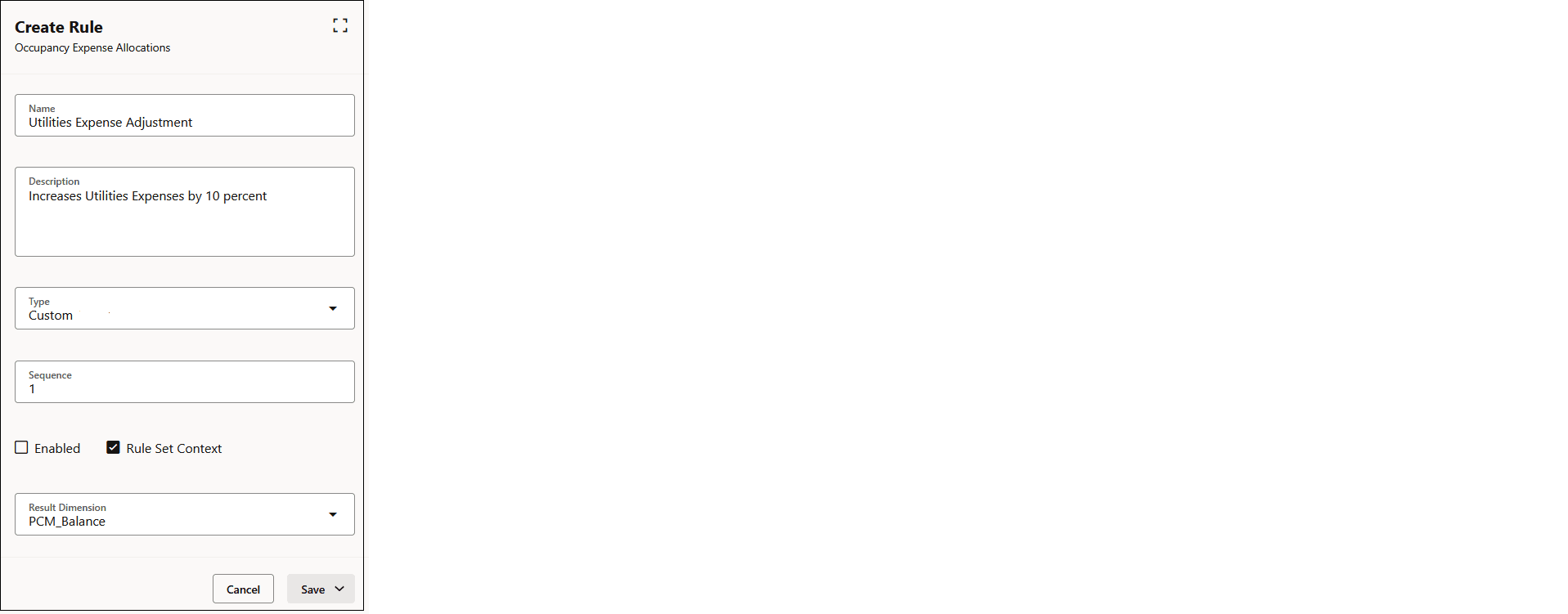
In the Create Rule panel, enter the following information:
-
Name: Enter a name for the rule.
For example, the "Occupancy Expense Allocations" rule set in the the BksML50 sample application provided with Enterprise Profitability and Cost Management, contains a custom rule called "Utilities Expense Adjustment".
Rule names have the same restrictions as the member names in Oracle Essbase. See Naming Restrictions for Dimensions, Members, and Aliases. -
Description: Enter a description for the rule.
For example, you could say something like; "Increases utilities expenses by 10%"
The description you enter here will appear in the Model Documentation report. Enter a description that will make the information about the custom rule informative for anyone reviewing the model logic in the future. See Generating a Model Documentation Report.
-
Type: Select Custom.
-
Sequence: Enter a number to determine the order in which the rule will run in the rule set.
The Sequence can be any whole number from 1 to 9999.
Rules with the same sequence number will run at the same time if parallel calculation is enabled for the parent rule set, and depending on the number specified for Calculation Threads in the Applications Settings. (See "Step 5: Select a Rule Set Calculation Option" in Creating a Rule Set and "Calculation Threads" in About Managing Application and System Settings.)
-
Enabled: If selected, the rule will be active when the calculation is performed.
-
Rule Set Context: If selected, the member selections done when the rule set was created will apply to this rule. If a Model Context has been enabled for the rule set, it will also be applied. See Understanding Model and Rule Set Context.
-
Result Dimension: Select a result dimension. The Result Dimension defaults to the PCM_Balance Dimension.
-
-
When you are finished entering the information in the Create Rule panel, click Save, and then select either:
-
Save and Close to return to the Waterfall Setup tab, or
-
Save and Next to continue adding rule definitions for additional rules
-
In the following example, the Utilities Expense Adjustment rule is defined as a Custom rule and will be the first rule run in the Occupancy Expense Allocations rule set. It will not be enabled by default, it will use a previously-defined Rule Set Context, and PCM_Balance is the Result Dimension.
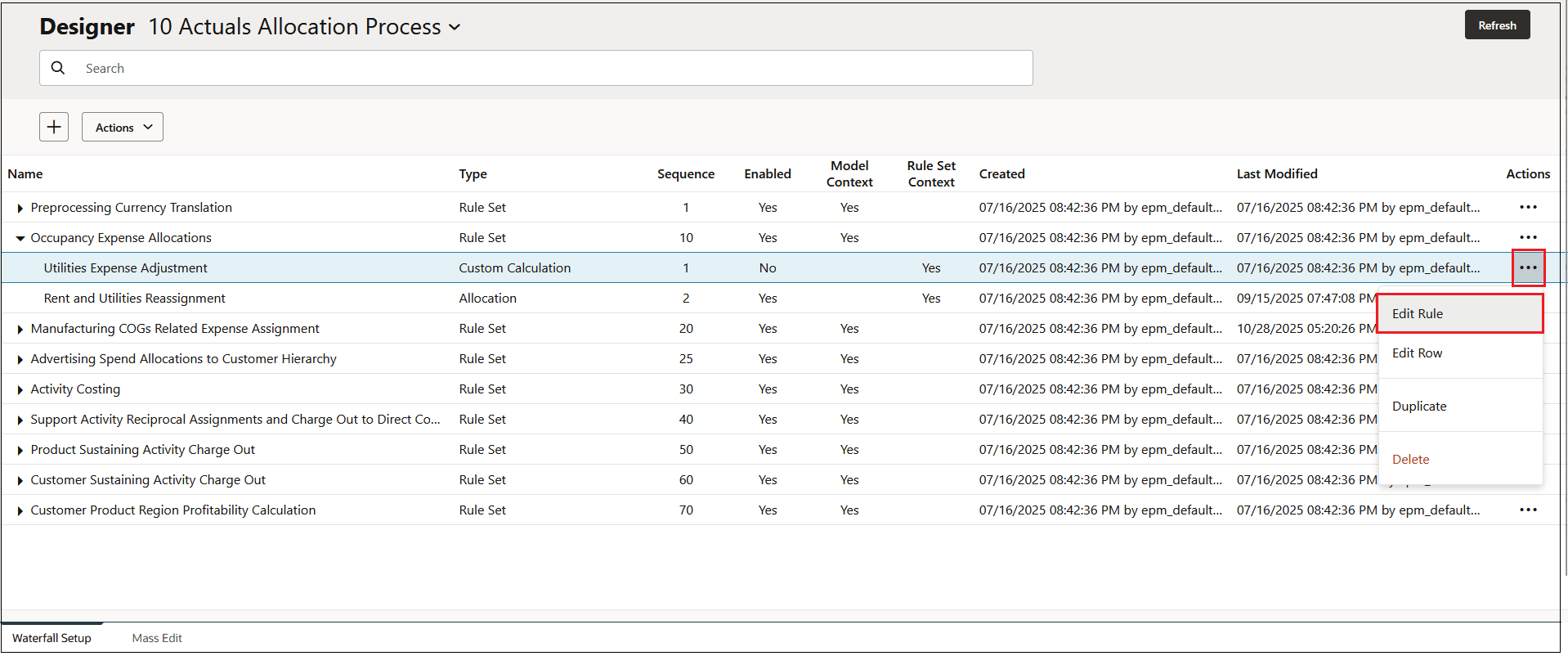
The rules defined in the Create Rule panel are displayed in the
Waterfall Setup tab. Click next to a rule, and select Edit Rule to enter additional
information about the custom rule.