About Aggregate Table Fragments
Data at an aggregation level can be stored in multiple physical tables. In such cases, you need to specify which logical table source contains which fragment of the data so that the Oracle Analytics query engine chooses the correct source for the query.
For example, suppose you have a database that tracks the sales of soft drinks in all stores. The detail level of data is at the store level. Aggregate information is stored at the city level for the sales of Coke and Pepsi, but there is no aggregate information for the sales of 7‐Up or other sodas.
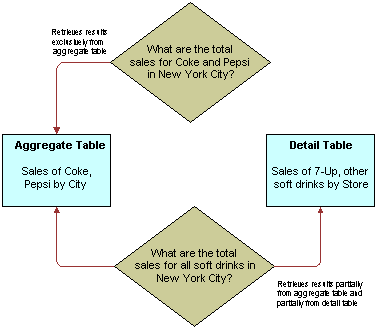
The goal of this type of configuration is to maximize the use of the aggregate table. If a query asks for sales figures for Coke and Pepsi, the data should be returned from the aggregate table. If a query asks for sales figures for all soft drinks, the aggregate table should be used for Coke and Pepsi and the detail data for the other brands.
The Oracle Analytics query engine handles this type of partial aggregate navigation. To configure a semantic model to use aggregate fragments for queries whose domain spans multiple fragments, you need to define the entire domain for each level of aggregate data, even if you must configure an aggregate fragment as being based on a less summarized physical source.