Operational Modes
SRTP topologies can be reduced to three basic topologies which are described in the following sections.
Single-Ended SRTP Termination
Single-ended SRTP termination is illustrated in the following figure.

Single-Ended SRTP Termination
If SRTP is enabled for the inbound realm/interface, the Oracle Communications Session Border Controller handles the incoming call as specified by the Media Security Policy assigned to the inbound realm. If there is crypto attribute contained in the offer, the Oracle Communications Session Border Controller parses the crypto attributes and optional parameters, if any. If the offer contains a crypto attribute or attributes compatible with the requirements specified by the SDES profile assigned to the Media Security policy, it selects the most preferred compatible attribute. Otherwise, the Oracle Communications Session Border Controller rejects the offer. Before the SDP is forwarded to the called party, the Oracle Communications Session Border Controller allocates resources, established SRTP and SRTCP Security Associations and updates the SDP by removing the crypto attribute and inserting possibly NAT’ed media addresses and ports. At the same time, the original crypto attribute is also removed from the SDP.
Once the reply from the called party is received, the Oracle Communications Session Border Controller inserts appropriate crypto attribute(s) to form a new SDP, and forward the response back to the calling party.
Back-to-Back SRTP Termination
Back-to-back SRTP termination is illustrated in the following figure.
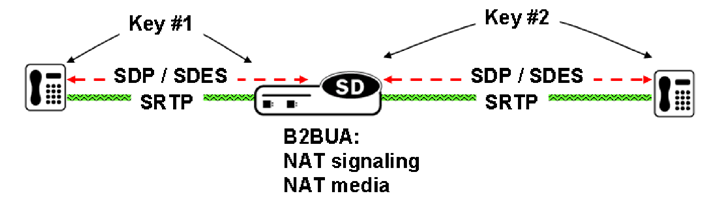
Back-to-Back SRTP Termination
Initial processing is similar to the single-ended termination described above. Before forwarding the request to the called party, the Oracle Communications Session Border Controller replaces the original crypto attribute with a new one whose crypto attribute conforms to the media security policy for the outbound realm/interface. Upon receiving the answer from the called party, the Oracle Communications Session Border Controller accepts or rejects it, again based upon conformity to the media security policy. If accepted, the Oracle Communications Session Border Controller replaces the original crypto attribute from the called party with its own to form a new SDP, which it forwards back to the calling party. At this point, SRTP media sessions are established on both sides for both calling and called parties.
SRTP Pass-Thru
SRTP pass-thru is illustrated in the following figure.
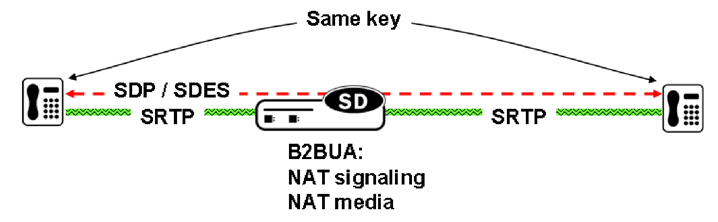
SRTP Pass-Thru
If the media security policy specifies pass-through mode, the Oracle Communications Session Border Controller does not alter the crypto attribute exchange between the calling and the called party; the attribute is transparently passed.